Listen. Think. Speak. Write.


Showing posts with label life lessons. Show all posts

Friday, June 17, 2016

What would Ma and Pa do?

I'm back.  I think.  I want to be anyway.  Now, that summer is here, I'm trying to carve more time for writing-related activities, and this blog has been pushed aside for too long.

Like most people, my heart has been heavy the last few days.  Politics are frustrating to say the least. The massacre in Orlando is both depressing and infuriating. The internet is filled with bad news, over-reaction, judgement, finger-pointing, pathetic argumentation/rhetoric, self-promotion, and hatred.  I'm tired of it.  And you have to know, I love the internet.  I'm sure I'm addicted.  Even so, I kind of want to run away for awhile, but every day, I feel on edge, and I'm sure it's connected to how much nastiness I'm reading on a daily basis.

I've been wanting to blog or respond to so many things, but I can't think of a valuable or original way to contribute to the conversation.  Plenty of people have said what I'm thinking.  Plenty of people yell and throw stuff at them.  And back and forth it goes.

One of the reasons I read and write YA and MG fiction is because at it's heart, children's literature is hopeful. People make mistakes, and they are forgiven.  Bad people find karma knocking on their front doors. It's a world in which characters experience emotions such as love and heartache for the first time--so many powerful feelings, so many struggles.  Still, in the end, the characters grow and learn and thrive.

One of my favorite book series while growing up was Little House on the Prairie.  
Who didn't love it? I adored the T.V. series, too.  In the wake of so much
cruddiness all around me, I can't help but think, "What would Pa do?'

And you know what's funny?  I'm not the only one to think this way because a quick Google search yielded far more entries on "lessons learned from Little House" (link 1, link 2, link 3)  than I expected.  So, yeah, I guess I'm not that original, but I still want to go there.  I'll keep in short.

1. When new people come to town, welcome them.

Pa didn't care what you looked like or where you came from or how you got there, he would always be there to shake a hand and offer to help each new person who came to town.

2. Listen and respect each other.

People on the prairie didn't always agree, even in the closest of relationships.  Even in a world of traditional gender roles, when Ma and Pa had differences, there was mutual respect and admiration. 

3. Bullies don't win because in the end, they are never happy.

Nellie and Harriet, anyone?  They were cruel and judgmental with others, but it was clear that they didn't like themselves very much, and it never got them very far.  

4. Life is complicated and sometimes doing the right thing is, too.
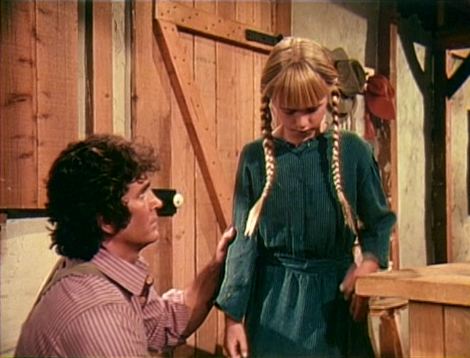
Remember when Pa made shoes for Olga even though her dad didn't want him to?  Or when Amy Hearn faked her own funeral in order to get her kids to visit? Characters in the show faced all kind of very real problems, from loss to substance abuse to racism and sexism. Sure, it's a T.V. show, and there was always a resolution, but that didn't mean it was easy.  

It means that life is messy.  It means sometimes, we have to step out of our comfort zones and stand up for others even if it would be easier to keep our heads in the sand.  It means we may have to put our own needs above others. It should force us to ask questions like, "How does this benefit my community?  What can I do to help others? Am I fighting because I want to be right or because the cause really is right for everyone?"

I've said before, watching the first few seasons of Little House pretty much teaches you everything you need to know about being a good person.  

Maybe the Internet could have one giant watch-along! 

Did you have a favorite episode?  Or book that helps center you on important life values?  

As a writer, a teacher, a critic, and a parent, I'd love to call for a little less anger and a lot more Little House. 

Wednesday, September 2, 2015

The positive side of insecurity

Most folks in my social circle have already heard the good news.  My debut novel will be published in Fall of 2016 by Sky Pony Press.  I am obviously over-the-moon.  It's the big one, right?  Dream come true, bucket list kind of stuff.  It's the end goal of this whole thing, so by definition, it should mean I'm no longer insecure, right?  Well, not exactly.

First of all, despite seeing the announcement in print and even seeing that it's already got a goodreads page, I'm not sure it feels real just yet.  I could say that'll come when there's a cover, but I'm guessing I'll need to see the book in print before reality sets in.  Even then, who knows? 

More than that though, I've been thinking about the very concept of insecurity.  There's the definition most of us use: "An uncertain or anxiety about oneself; lack of confidence" which is what we're all dealing with in these monthly posts and support for each other.  It's rooted in a deep sense of not feeling good enough. 

On the other hand, we can twist this a bit.  Another definition of insecurity is "the state of being open to danger or threat; lack of protection." That's scary, sure, but it implies risk and the potential for reward.  It's about action and putting ourselves out there. 


After I got my agent, I did a series of posts about that process and some lessons learned.  I'm going to do something similar now in describing the submission process and beyond.  I've found that throughout this whole journey, the more I knew about what to expect, the less my insecurity crippled me.  The more I felt okay with being open to danger, so to speak.  

For now I say, embrace your insecurity.  

Keep trying to do things that you may not feel confident doing, that involve risk.  

Friday, November 21, 2014

Get by with a little help from some feathers

So, I recently bought myself in a winter coat in which I’m pretty sure I look a little like an over-roasted sta-puffed marshmallow woman (the coat’s black after all).  I’m undecided about whether purchasing such a coat, weather rated to -45 degrees, means that I have finally conquered winter or that it’s actually bested me.  At the end of the day, I don’t care because the dang thing makes me feel like I might possibly survive another year living in Frozen Land (which wouldn’t be so bad if it were like Disney and had talking snowmen and singing trolls).


The thing is, I’m not sure why I held out so long buying a ginormous coat.  Seriously, the thing comes below my knees, and I’m 5’ so it’s kind of comical.  Ask anyone and they will tell you, it’s not like I put on a brave winter face or feel the need to be “tough” about it. I whine and complain ALL THE DANG TIME about how cold I am.  Why wouldn’t I have sought out better ways to manage it sooner?

The more I think about it, the more I realize how often I see people taking the same approach on other things in life.

“I have a headache.”  Did you take anything?  “No.” 

“I’m not sure how to write this paper.”  Did you read the instructions?  Have you gone to the tutoring center?”  “No.”

There are probably a million different reasons why we don’t seek the right support or utilize resources available to us when faced with a problem.  Maybe we’re lazy.  Maybe we don’t care enough.  Maybe we’re afraid to admit we can’t do something alone.

My coat and I are here to say that’s probably not the best way.  I can’t believe how much it has lifted my mood to get in the car and not feel like my entire body was going to turn into an icicle and then break into a million pieces.  Being able to find the right tool to support me has lifted a burden in a way. 

It’s also served as a reminder that we all sometimes need a little help.  Maybe from friends and family.  Maybe from co-workers. Maybe from fellow-writers.  Maybe from a therapist. Maybe from 600 fill-power down insulation.


Whatever you need, maybe it’s time to accept a little help.    

Friday, November 7, 2014

Be a tree.

Every once a great long while, I write a little letter to one of my kids and save it.  I had always intended for it to be this great volume that they'd get to read on graduation or something.  All kinds of life wisdom imparted as well as a general sense of knowing how loved they were through the busyness of life.  Well, my volume is pretty thin as I seem to remember about once a year, if that.  I managed to set some words to paper last week, and I came across this nugget for several years back written for Grace.

11/24/04

“Sometimes it’s good to be the tree.”

The other night, we read The Giving Tree. As usual I cried.  I’m not sure I have ever read that story without tears streaming down my face.  I don’t think I’d read it since becoming a parent though.  Bill looked at me and suddenly said, “Oh he wrote that book about his mom, didn’t he?”  It made so much sense. 

Later, we put you to bed.  You were fighting it, as always.  At one point, you grabbed my head and pulled me close so my head was resting on your face.  I admit, I wasn’t very comfortable.  I looked over at Bill, and said, “Sometimes it’s good to be the tree.” 

Some people get mad when they read The Giving Tree.  It's easy to focus on how much the boy takes the tree for granted.  And I know as a parent, I sure empathize with that sentiment.  But at least in the month of Thanksgiving as we move into what I hope is a reflective and joyous time of year, I am going to focus on being grateful for the trees in my life.  A mom who never declines a request to pick up my kids and folds about 90% of my laundry.  A husband who puts up with all the ways I add "busy" to our lives. Friends who are always willing help with the kid shuffle.  Without support none of us would grow into strong trees ourselves.  To be there for our kids and friends and other family members when they need us.  As strange as it sounds, at least today, I'm also going to appreciate the opportunity to be taken for granted.  

I like being a tree. 

And if we are all trees, then we become a forest. 


"And the tree was happy."

Tuesday, October 28, 2014

How NaNoWriMo is like Life.

I'm back!  This year, I'm serving as Interim Associate Dean, so my writing life has been fairly limited, but I'm preparing for that to come to an end in December, so I'm trying to put my mind back into writing mode.  As everyone gears up for NaNoWriMo (National Novel Writing Month) in a few days, I reflected on my own Nano experiences.  The goal is simple:  Write at least 50,000 words of a novel in a month.  Ultimately, all three of my completed novels were largely composed during either NaNoWriMo or a Camp NaNo. So, I came up with three "tips" for successfully NaNo'ing that also apply to everyday 


1. Just write.  Don’t think.  It’s counter intuitive to many writers because it’s hard to imagine not editing as you go, but sometimes it really is good to get it all down on paper.  There will be times when are sure that everything you’re writing is pure crap, and you’re certain there will be no way to salvage it.  In fact, I felt that way EVERY time.  But it’s worth it just to get those words on paper.  So many of them.  50,000 of them!  It’s something to work with.

That’s the day to day of life isn’t it?  Just get busy doing instead of planning and second guessing.  You’ll make dumb mistakes but there will likely be more good than bad by the time you’re done.


2.  Take time before you review. Agents say they get bombarded with folks who submit their novels in December, clearly not having been through any editing.  I actually suggest not editing that novel right away.  Give it a few weeks (I usually wait up to 6 months before opening a Nano novel).  I’m too close to it after that intense writing.  I wouldn’t be able to see the forest for the trees. 

We’re so quick to want to critique/correct that we don’t always give ourselves time to just bask in the accomplishment, to let things settle. Sometimes, we do things that me might immediately regret, but time may alter our perception.

3.  Support each other.  The very best part of NaNo is that we're all in it together.  From Twitter (#NaNoWriMo) or #nano) to Facebook groups to official NaNoWriMo forums to local writing groups, there are like-minded people everywhere who are struggling.  They will be your cheerleaders!  You can sprint together and whine together and celebrate the end together.  You may find some of those same people become part of your general writing circle when it's over.  So, be sure to cheer them on, too.

Life is not a solo adventure either.  Find people to join on the journey who support you and lift you up.  Let go of those who don't.  But don't forget that you need to be there for others, too. 

Happy writing, happy living! 


Wednesday, May 7, 2014

It's not you; it's me.

"It's not you; it's me."  Class break-up line right? Maybe even cringe-worthy.  

We tend to think of it as an excuse when people don't know what else to say, but maybe that's a bit harsh because it's often true.  It doesn't mean there's anything wrong with either of you; you're just not necessarily right for each other. 

What about this one?  "If I'd just met you sooner…"  or "I'd totally marry you in ten years". Yeah, it doesn't feel any better, but think house hunting.  Maybe this particularly house would be great in five years, but it doesn't work for you today because of some circumstance--proximity to a school or an infant that needs a room close to a master bedroom.  Ultimately people's needs change. 

That brings me to Query Lesson #3. Whether we're searching for a house, a job, a friend, love, or an agent, sometimes, two things drive the match:  "fit" and "timing."  

Thursday, March 27, 2014

Rejection is good.

I know I said I learned three lessons in the query process, but it's shaping up to be four.  As always, my writing experiences can be applied to so many aspects of life.  I'm in awe of the ways we, as humans, continue to learn the same lessons over and over again just in different contexts.  I suppose it could depress me.  I mean, really, how dense can we be?  Instead, I choose to think maybe it's all reinforcement.  So, the next lesson isn't really new, but I appreciated the reminder.

Lesson #2:  Rejection can be a good thing.

So listen, rejection sucks.  I think I've covered that.  It hurts.  It's personal.  It's a hit to the self-esteem.  That's true whether we're talking about a job, a guy at a bar, a friend who stops calling, or when only a few people "like" the Facebook status you thought was a masterpiece.  Your throat clogs up, and your chest gets tight, and suddenly you wonder why you even bothered in the first place.  Okay, fine, maybe you don't have as visceral a reaction to rejection as I do, but just check out these Reddit users' stories of rejection if you want to know how crappy it feels.

Rejection is important, though.  I'm sure I could find a million and one clichés to illustrate my point, but we have to face rejection in order to improve.  We have to face rejection to know that we needed to improve in the first place.  At the same time, we have to be willing to hear what the rejector is saying in order to change. 

Tuesday, December 17, 2013

Building Support

Everything built requires support. Beams, posts, trusses, footings.  I probably should just quit with this analogy now because I don't actually know anything about construction, but the general principle applies. Without the appropriate support, structures fail.  It can take years.  It might lead to a minor crack or total devastation.  

As I get deeper into the novel querying process again and as the end of the semester nears, causing my students to scramble or to go numb, I'm struck by the important lessons regarding support we can learn from home improvement shows.  A solid foundation is hard work, but the lesson of the day is: plenty of help is available, but you probably won't find it unless you seek it out.

When I think about it, I bet in most situations where I feel most alone and afraid it only takes a few clicks, a phone call or even a smile to start building a support network.  The most challenging part is that when we are most vulnerable is when we have to make the effort to reach out.  I know my insanely busy students probably feel like the world is about to cave in on them, but there are tutors and friends and family would be happy to help hold up the walls if only they were asked. 

Wednesday, April 10, 2013

The more things change


A few weeks ago, I talked about transitions and how to pay attention to both the monumental and the subtle changes.  Clearly, people are capable of change. 


On the other hand, I think there’s a pretty substantial part of all of us that is just fundamentally never going anywhere, and it probably shouldn’t.  Once, my husband I were talking about our kids’ futures, and he said, “It’s impossible to tell what they’ll be into as an adult and what kind of a career they’ll want.” 

I’m not so sure.  When I considered what each of us wanted to be when we were little, what our dreams were growing up, not much had changed.  Probably somewhere in this house, there’s a journal from when I was around eleven with “Write a bestseller” at the top of a list of future goals.  So many people hold on to that childhood goal either as a career or a hobby, or at least there’s some core characteristic that forges their paths.  My husband wanted to be an architect, and he’s a civil designer, fork in the road but not a different highway altogether.