Listen. Think. Speak. Write.


Showing posts with label writing. Show all posts

Tuesday, August 2, 2016

Pumped up for PitchWars!

I'm so excited to be serving as a co-mentor with the amazing Laura Shovan in this round of PitchWars. You can view all the details of our preferences and interests on her blog. The big day is almost here:  It's down to hours before we'll be open for submissions.  It's going to be interesting to be on the other "side" of things.

I know what it's like to get the email requesting more material. 


I also know what it's like to receive rejection letters.  Lots of them.


I have numerous blog posts about my query journey and then my submission story.  Both requires patience and perseverance. Thankfully, my alter ego is "Tenacious T" because I sure didn't get through this process because of my patience.

Here are a few things to remember (and hey you can use this for more things than PitchWars!)

  • It's not personal.  
It may FEEL personal.  All rejection feels personal, but unless only one person submits to my partner and me, we will have to choose only one mentee.  In our case, we'll also be negotiating two potentially different opinions. We may be equally devastated to walk away from a manuscript and/or author.
  • You are not a failure.
I know people have said this like a million times over, but seriously, you wrote a manuscript.  You're doing great.  If you don't get selected as a mentee, the journey doesn't end.  I didn't.  And less than six months later, I had an agent.  
  • It isn't luck.
I put this in here because sometimes when we face rejection we try to come up with reasons why we didn't succeed, justifications. I often hear people talk about how someone just got lucky.  In the world of book publishing, that's pretty rare.  It's because of the work put in; not just any work, the right work.  I have manuscripts I'm still revising after like seven years because they simply aren't ready.  
  • Relationships are good.
This is another thing I hear a lot--it's about who you know.  A little.  Sure.  It can help.  Relationships are especially good at helping you figure stuff out and finding good critique partners. 
  • But the writing comes first.

Polish that manuscript!


Good luck!  Team TLC cannot wait to read those submissions!


Monday, July 18, 2016

A Book that Stays Gold

In my last blog post, I linked my Sweet Sixteener bio, and I hinted that my next blog topic was in that post.  Did you read it?  Did you guess?

I'm currently gearing up to be a Pitch Wars mentor, and I'll be talking quite a bit about that in the upcoming months.  It sparked reflection on my favorite middle grade novels (some border YA).  I'm going to start with a couple from my youth and then move into some more contemporary options. I already talked about my love for Little House, so next up has to The Outsiders, by S.E. Hinton

I cannot begin to express the level of freakishness that I achieved in my love for this book.  I mentioned it in my bio post on the Sweet Sixteens, but I lost count of how many times I read it, at least twenty one summer alone.  I really did put Vaseline in my hair in my effort to pretend I was a the long lost Curtis sister.  I went to camp that summer, and people thought I was a total nut job because I wouldn't put the book down (I'm sure they were right). 

If the internet had existed, I have no doubt I would have discovered fanfiction and fan communities more than twenty-five years sooner than I eventually did. 

What was it about that book?  

Who knows why we connect so deeply to some stories, movies, T.V. shows, music, etc. more than others?  Thank goodness for choices that allow us to all find our escapes in different ways.

Ultimately, though, I think there are three things that made The Outsiders so powerful to me.

1. The world-building. No, it's not Narnia.  Tulsa is real.  The era is real.  It's that a great story kidnapped me and held me captive even in a place decidedly different from my midwest, middle class, lifestyle. I entered a world of rebellion and youth at a time when I was just beginning to exert independence.  

2. Theme of injustice. I have a love/hate relationship with this theme.  If it goes to far, I get mad and I'll stop reading. This story was more revelatory than anything.  It demonstrated how socio-economics impacts both general groups of people as well as specific individuals.  It was an early and powerful lesson for me about privilege, and Cherry Valence, and identifiable character who taught me about the diffic
ulties of speaking out about injustice.

3. Emotional explosion. Media use theories teach us that one immense value of popular culture is the ability to experience emotions in guilt free environments.  What a roller coaster this story was, with two major character deaths, hints of love, family struggles, anger, and ultimately a journey to catharsis. 

My most-read, beloved favorite childhood book.  I'll be talking about more favorites, but I'm curious.
What book have you read the most?

Friday, June 17, 2016

What would Ma and Pa do?

I'm back.  I think.  I want to be anyway.  Now, that summer is here, I'm trying to carve more time for writing-related activities, and this blog has been pushed aside for too long.

Like most people, my heart has been heavy the last few days.  Politics are frustrating to say the least. The massacre in Orlando is both depressing and infuriating. The internet is filled with bad news, over-reaction, judgement, finger-pointing, pathetic argumentation/rhetoric, self-promotion, and hatred.  I'm tired of it.  And you have to know, I love the internet.  I'm sure I'm addicted.  Even so, I kind of want to run away for awhile, but every day, I feel on edge, and I'm sure it's connected to how much nastiness I'm reading on a daily basis.

I've been wanting to blog or respond to so many things, but I can't think of a valuable or original way to contribute to the conversation.  Plenty of people have said what I'm thinking.  Plenty of people yell and throw stuff at them.  And back and forth it goes.

One of the reasons I read and write YA and MG fiction is because at it's heart, children's literature is hopeful. People make mistakes, and they are forgiven.  Bad people find karma knocking on their front doors. It's a world in which characters experience emotions such as love and heartache for the first time--so many powerful feelings, so many struggles.  Still, in the end, the characters grow and learn and thrive.

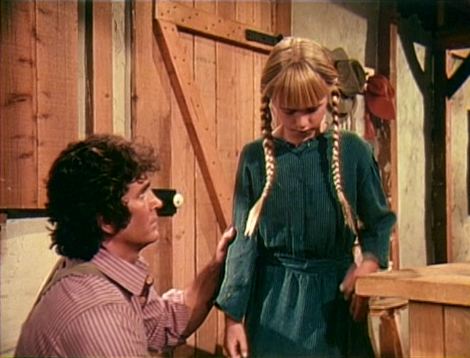
One of my favorite book series while growing up was Little House on the Prairie.  
Who didn't love it? I adored the T.V. series, too.  In the wake of so much
cruddiness all around me, I can't help but think, "What would Pa do?'

And you know what's funny?  I'm not the only one to think this way because a quick Google search yielded far more entries on "lessons learned from Little House" (link 1, link 2, link 3)  than I expected.  So, yeah, I guess I'm not that original, but I still want to go there.  I'll keep in short.

1. When new people come to town, welcome them.

Pa didn't care what you looked like or where you came from or how you got there, he would always be there to shake a hand and offer to help each new person who came to town.

2. Listen and respect each other.

People on the prairie didn't always agree, even in the closest of relationships.  Even in a world of traditional gender roles, when Ma and Pa had differences, there was mutual respect and admiration. 

3. Bullies don't win because in the end, they are never happy.

Nellie and Harriet, anyone?  They were cruel and judgmental with others, but it was clear that they didn't like themselves very much, and it never got them very far.  

4. Life is complicated and sometimes doing the right thing is, too.

Remember when Pa made shoes for Olga even though her dad didn't want him to?  Or when Amy Hearn faked her own funeral in order to get her kids to visit? Characters in the show faced all kind of very real problems, from loss to substance abuse to racism and sexism. Sure, it's a T.V. show, and there was always a resolution, but that didn't mean it was easy.  

It means that life is messy.  It means sometimes, we have to step out of our comfort zones and stand up for others even if it would be easier to keep our heads in the sand.  It means we may have to put our own needs above others. It should force us to ask questions like, "How does this benefit my community?  What can I do to help others? Am I fighting because I want to be right or because the cause really is right for everyone?"

I've said before, watching the first few seasons of Little House pretty much teaches you everything you need to know about being a good person.  

Maybe the Internet could have one giant watch-along! 

Did you have a favorite episode?  Or book that helps center you on important life values?  

As a writer, a teacher, a critic, and a parent, I'd love to call for a little less anger and a lot more Little House. 

Wednesday, December 2, 2015

Submission Process: Part II

Waiting.

More Waiting.

Then an offer!  Whoo hoo, the waiting is over!

Just kidding. 

I had heard stories over the years about how things move slowly in the publishing world, but I'm not sure I ever really understood that. 

It took about two months to go from the offer to a signed contract/announcement of the deal.  What was the delay?  First, we had to give time for other potential publishers to respond, just like in the query process.  In that time frame, I was able to have a conversion with my editor and get a feel for her vision, which was great. But what really took the most time? The contract itself.

This is the part where I say I am so glad I had an agent. 
I know that lots of people do this without an agent, but I would have had no clue how to read that document nor what was the most important aspect of negotiation, particularly in relationship to rights.

One of the things that became very clear is that it wasn't just having an agent, but having someone you trusted had your best interests in mind, someone who could explain why something was important.

I probably would have signed the first draft because I just wanted to be published so badly. 

And this was a small deal with a smaller publisher on what I perceive is a quiet book.  I can't imagine how complicated it gets with bigger books and bigger deals.

I've said this before in my blogging process, but it's a life lesson that I keep learning over and over.  You need to surround yourself with the right people, the right support and then let them support you.

I'm self-confessed control freak, pretty independent overall, but there's not a stage of the writing and publishing process that hasn't been improved by trusting other people to help me. 
It kind of makes me wonder if I'll ever remember that in other aspects of my life, too. 


How easy is it for you to let go of control?  

Monday, September 28, 2015

Submission Process Part 1: Dante and the waiting game

Previously, I talked about the process of finding an agent (it was long and I made many mistakes). I also wanted to share my experience taking a manuscript to publishers.  I know this will be more valuable for the writers out there, but this process has taught me many lessons about patience and accepting the unexpected.  It's also shaped new ideas about how to measure success.  Perhaps, those will be useful to you. For this post, then, I'll give more of a brief background and move into the lessons next time around. 


When I was querying, it seemed as if  finding an agent was the holy grail.  If I could just land an agent, my path to publication would look like this:


Straight, narrow, and with the perfect final destination. 

Ah, if only.  It probably looks a little more like this:


Rocky, difficult, and with unknown destination.

My agent and I worked for a couple of months to get the manuscript in tip top shape before she sent it off to editors. It was finally official.  I was "on submission," and I was equal parts excited and nervous.  

On the absolutewrite forums, they refer to being on submission as the next circle of hell, and while I wouldn't say it's quite that bad, it's definitely true that being becoming agented is a step toward publication.  Much like writing itself or querying, for some folks, a sale is practically instant.  Others may have to move on to another project. Obviously, an agent won't take you on if they don't think they will be successful, but they can't predict everything either. 

I admit I was relieved to be on submission probably more than anything.  After such a long query process where I had to actively monitor everything, I could just sit back and wait.  And I had to wait a long time. It took us about six months before we got any feedback.  My agent had prepared me for potentially slow responses, but that certainly put a damper on my dreams.  Still, life was busy, and I managed to forget to worry about it for months at a time.  Then my agent and I would touch bases with new rejections (all maddeningly positive, as Jen said).  After a year, though, I pretty much assumed it was time to let it go.  I started talking to Jen about which manuscript to prepare next.  

Like that proverbial watched pot that doesn't boil, the minute I started thinking more about other projects, I got the amazing news about an offer.  

As joyful as it was to get the news, I think all the waiting and the fear made it difficult to fully embrace and accept that it's real.  

Plus, the waiting isn't over.

Stay tuned for Submission Process Part Two: Serious business (and more waiting).  I'll post that next week as part of the Insecure Writer's Group for the first Wednesday of the month. 

In the meantime, does waiting build your anticipation? Are you able to avoid negative thoughts when waiting for news?

Wednesday, September 2, 2015

The positive side of insecurity

Most folks in my social circle have already heard the good news.  My debut novel will be published in Fall of 2016 by Sky Pony Press.  I am obviously over-the-moon.  It's the big one, right?  Dream come true, bucket list kind of stuff.  It's the end goal of this whole thing, so by definition, it should mean I'm no longer insecure, right?  Well, not exactly.

First of all, despite seeing the announcement in print and even seeing that it's already got a goodreads page, I'm not sure it feels real just yet.  I could say that'll come when there's a cover, but I'm guessing I'll need to see the book in print before reality sets in.  Even then, who knows? 

More than that though, I've been thinking about the very concept of insecurity.  There's the definition most of us use: "An uncertain or anxiety about oneself; lack of confidence" which is what we're all dealing with in these monthly posts and support for each other.  It's rooted in a deep sense of not feeling good enough. 

On the other hand, we can twist this a bit.  Another definition of insecurity is "the state of being open to danger or threat; lack of protection." That's scary, sure, but it implies risk and the potential for reward.  It's about action and putting ourselves out there. 


After I got my agent, I did a series of posts about that process and some lessons learned.  I'm going to do something similar now in describing the submission process and beyond.  I've found that throughout this whole journey, the more I knew about what to expect, the less my insecurity crippled me.  The more I felt okay with being open to danger, so to speak.  

For now I say, embrace your insecurity.  

Keep trying to do things that you may not feel confident doing, that involve risk.  

Wednesday, August 5, 2015

Definitions

Words are such amazing things—tricky, too.  The very fact that we've used these arbitrary symbols to create such a complex system of communication is fascinating.  Language seems so simple now, right?

And wonderful.  How do you feel when someone utters three easy words, "I love you?"
Except think of the trouble words get us into.  The misunderstanding, the confusion, the anger. 
One of the first things people do when trying to belittle someone is to call them names—to attempt to re-define the other person. A key strategy in controlling others is to manage their language and how they are defined.

Any way we label a person, place, situation, thing, idea, etc. limits how others will view it.  That's true even if it's labels we give ourselves.  How many words do you use to define yourself?  My "twitter" definitions says I am a "wife, mom, college professor, travel planner-extraordinaire, and wanna-be-middle-grade writer." 


What would it mean to move from wanna-be to "writer?"  When is it okay to define yourself as a writer?  Obviously, this isn't a question limited to writing, but as it's the first Wednesday and the month, it seemed like an appropriate topic for the Insecure Writer's Group.


In this case, I think I equate using the label as a definition with being successful at it, not just the act of doing the writing.  That's not something we do with everything right?  I'm a mom even if I'm not a very good one (and I think I'm okay there). 

This is a little nudge to us all that as upset as we can get at the labels others put on us, the ones use on ourselves can be just as problematic. 


Writers, when are you willing to call yourself one? 

Thursday, June 25, 2015

Repetition versus repetitive


I've been binge reading the words of a popular author recently.  Obviously, I generally enjoy the books or I would have stopped after the first one.  However, now that I'm like 5 in, I'm seeing patterns that have begun to annoy me as a reader—for example, a very controlling mother and a very fast resolution (too quick to resolve big issues, IMHO) among others.  Readers, viewers, listeners generally like repetition.  People enjoy the familiar and appreciate knowing what to expect.  It's why formula works so well in TV and movies. 

However, it's a fine line, though from repetition to repetitive.  Once that line is crossed though, we move from expectation to boredom.

Doesn't that sound a little like the workplace?  It's nice to know what you're supposed to do from day to day.  It's great when you can feel like you've mastered things, but there's got to be a little zing in there or it becomes so mind-numbingly boring that you spend your days dreaming up extravagant ways to quit.  Or at least watching YouTube videos of people who really did it with flare.  This woman is most certainly, "Gone," for example.  


Or how about your exercise routine?  Why do you think I have umpteen million different work out DVD's in my house AND a gym membership? I bore way too easily.

I'm not saying that life has to be all glitz and glory all the time.  One of the most important lessons I'm constantly telling my kids is that you have to go through some of the boring to get to the good stuff.  Routine ballet class with its focus on skill and repetition must precede winning at dance competitions. 

For that reason, I expect some repetition when reading and writing and even living.  I know there are boring parts to everything we do.  

But as soon as repetition feels too repetitive, the audience is probably lost.  

What are you ruts?  If you write, what are your repetitive habits?  

Wednesday, June 3, 2015

Variety and the imperfect perfection

I used to be a part of a monthly blog hop called the "Insecure Writer's Group" but I'd been letting that slide.  I valued that experience so I'm "hopping" back in. One of the things I've found most valuable over the years is the way in which my writing lessons have connected to life lessons.  Learning a new skill has given me so much perspective on everything else I've already learned, and I'll carry on that perspective today.

Aspiring writers are told to be voracious readers.  Agents, editors, and fellow writers insist that reading improves writing—makes sense, right?  It gives authors an understanding of market and genre, helps them notice concepts of voice and story development which may either subtly or directly influence one's own writing.

Potentially, reading also changes perspective about your own writing. One of the things that happens when you read a lot is that you don't like every book.  You might even hate some.  It's possible you'll even despite a book that everyone in the world things is the best thing ever written.  You might really enjoy a book or an author who "serious" critics say is too formulaic or sophomoric (or YA or fanfic or "trashy" novels). 

The point is, we all have different expectations and different preferences, right?  As a writer, it lets me off the hook a bit.  Perfection is relative ... to what?  Good is relative to what?  Now, that doesn't mean I advocate writing crap, but it's a good reminder.

As a public speaking teacher, I constantly tell my students that good speaking isn't one-size-fits-all.  It's about being an authentic communicator, about your ethos.  You need to be the best YOU possible even if you have some delivery flubs and or your voice is high-pitched.  It may be what audiences most like about you.


The same goes for writing, it goes for your job and your relationships and your art and your music and your bathroom remodel and everything else under the sun.  The more variety you experience, the more you're able to find yourself in the process. 

Your imperfections are an important part of your voice.


Tuesday, October 28, 2014

How NaNoWriMo is like Life.

I'm back!  This year, I'm serving as Interim Associate Dean, so my writing life has been fairly limited, but I'm preparing for that to come to an end in December, so I'm trying to put my mind back into writing mode.  As everyone gears up for NaNoWriMo (National Novel Writing Month) in a few days, I reflected on my own Nano experiences.  The goal is simple:  Write at least 50,000 words of a novel in a month.  Ultimately, all three of my completed novels were largely composed during either NaNoWriMo or a Camp NaNo. So, I came up with three "tips" for successfully NaNo'ing that also apply to everyday 


1. Just write.  Don’t think.  It’s counter intuitive to many writers because it’s hard to imagine not editing as you go, but sometimes it really is good to get it all down on paper.  There will be times when are sure that everything you’re writing is pure crap, and you’re certain there will be no way to salvage it.  In fact, I felt that way EVERY time.  But it’s worth it just to get those words on paper.  So many of them.  50,000 of them!  It’s something to work with.

That’s the day to day of life isn’t it?  Just get busy doing instead of planning and second guessing.  You’ll make dumb mistakes but there will likely be more good than bad by the time you’re done.


2.  Take time before you review. Agents say they get bombarded with folks who submit their novels in December, clearly not having been through any editing.  I actually suggest not editing that novel right away.  Give it a few weeks (I usually wait up to 6 months before opening a Nano novel).  I’m too close to it after that intense writing.  I wouldn’t be able to see the forest for the trees. 

We’re so quick to want to critique/correct that we don’t always give ourselves time to just bask in the accomplishment, to let things settle. Sometimes, we do things that me might immediately regret, but time may alter our perception.

3.  Support each other.  The very best part of NaNo is that we're all in it together.  From Twitter (#NaNoWriMo) or #nano) to Facebook groups to official NaNoWriMo forums to local writing groups, there are like-minded people everywhere who are struggling.  They will be your cheerleaders!  You can sprint together and whine together and celebrate the end together.  You may find some of those same people become part of your general writing circle when it's over.  So, be sure to cheer them on, too.

Life is not a solo adventure either.  Find people to join on the journey who support you and lift you up.  Let go of those who don't.  But don't forget that you need to be there for others, too. 

Happy writing, happy living! 


Wednesday, May 7, 2014

It's not you; it's me.

"It's not you; it's me."  Class break-up line right? Maybe even cringe-worthy.  

We tend to think of it as an excuse when people don't know what else to say, but maybe that's a bit harsh because it's often true.  It doesn't mean there's anything wrong with either of you; you're just not necessarily right for each other. 

What about this one?  "If I'd just met you sooner…"  or "I'd totally marry you in ten years". Yeah, it doesn't feel any better, but think house hunting.  Maybe this particularly house would be great in five years, but it doesn't work for you today because of some circumstance--proximity to a school or an infant that needs a room close to a master bedroom.  Ultimately people's needs change. 

That brings me to Query Lesson #3. Whether we're searching for a house, a job, a friend, love, or an agent, sometimes, two things drive the match:  "fit" and "timing."  

Thursday, March 27, 2014

Rejection is good.

I know I said I learned three lessons in the query process, but it's shaping up to be four.  As always, my writing experiences can be applied to so many aspects of life.  I'm in awe of the ways we, as humans, continue to learn the same lessons over and over again just in different contexts.  I suppose it could depress me.  I mean, really, how dense can we be?  Instead, I choose to think maybe it's all reinforcement.  So, the next lesson isn't really new, but I appreciated the reminder.

Lesson #2:  Rejection can be a good thing.

So listen, rejection sucks.  I think I've covered that.  It hurts.  It's personal.  It's a hit to the self-esteem.  That's true whether we're talking about a job, a guy at a bar, a friend who stops calling, or when only a few people "like" the Facebook status you thought was a masterpiece.  Your throat clogs up, and your chest gets tight, and suddenly you wonder why you even bothered in the first place.  Okay, fine, maybe you don't have as visceral a reaction to rejection as I do, but just check out these Reddit users' stories of rejection if you want to know how crappy it feels.

Rejection is important, though.  I'm sure I could find a million and one clichés to illustrate my point, but we have to face rejection in order to improve.  We have to face rejection to know that we needed to improve in the first place.  At the same time, we have to be willing to hear what the rejector is saying in order to change. 

Tuesday, December 17, 2013

Building Support

Everything built requires support. Beams, posts, trusses, footings.  I probably should just quit with this analogy now because I don't actually know anything about construction, but the general principle applies. Without the appropriate support, structures fail.  It can take years.  It might lead to a minor crack or total devastation.  

As I get deeper into the novel querying process again and as the end of the semester nears, causing my students to scramble or to go numb, I'm struck by the important lessons regarding support we can learn from home improvement shows.  A solid foundation is hard work, but the lesson of the day is: plenty of help is available, but you probably won't find it unless you seek it out.

When I think about it, I bet in most situations where I feel most alone and afraid it only takes a few clicks, a phone call or even a smile to start building a support network.  The most challenging part is that when we are most vulnerable is when we have to make the effort to reach out.  I know my insanely busy students probably feel like the world is about to cave in on them, but there are tutors and friends and family would be happy to help hold up the walls if only they were asked. 

Wednesday, April 10, 2013

The more things change


A few weeks ago, I talked about transitions and how to pay attention to both the monumental and the subtle changes.  Clearly, people are capable of change. 


On the other hand, I think there’s a pretty substantial part of all of us that is just fundamentally never going anywhere, and it probably shouldn’t.  Once, my husband I were talking about our kids’ futures, and he said, “It’s impossible to tell what they’ll be into as an adult and what kind of a career they’ll want.” 

I’m not so sure.  When I considered what each of us wanted to be when we were little, what our dreams were growing up, not much had changed.  Probably somewhere in this house, there’s a journal from when I was around eleven with “Write a bestseller” at the top of a list of future goals.  So many people hold on to that childhood goal either as a career or a hobby, or at least there’s some core characteristic that forges their paths.  My husband wanted to be an architect, and he’s a civil designer, fork in the road but not a different highway altogether.

Thursday, March 21, 2013

The importance of place


I just received feedback on one of my novel pitches that said (among other things) that he wanted a greater sense of the setting.  Ah yes, that old nemesis, setting.  It’s not really news that it’s important, and I sit here pondering the last several books I read, I can instantly recall aspects of time and place.  In fact, I think one of the reasons I loved Eleanor and Park is because it was situated in such a perfect way to make me feel like I had gone home.  Of course, place can be more than a town or a place, but it should lead to a state of mind.

I’m not writing this blog just to lament my writing weakness.  I find myself contemplating the importance of place in general, and I wonder if we’re discounting it a bit too much as a society.  In Popular Culture in the Media, we talk about “mass culture” and potential homogenization.  Simply put, between mass marketing/media and national chain stores and restaurants, there’s far less local culture than may have historically existed.  This probably truest in suburban America where no matter what the title of the city is, you can find the same Targets, Kohls, Olive Gardens, McDonalds, and Starbucks.  The uniformity and sameness is comforting in a way.  It saves time. Need  Tylenol?  Back left corner of Walgreens. 

Sunday, September 30, 2012

More in the Middle


Yesterday, the new semester started.  Wait.  Actually, tomorrow marks the start of the fifth week of the semester.  What the heck?  How did that happen?  I'm assuming I must have missed a time warp in September because there is no way October begins tomorrow.  Excuse me while I stomp my feet and shake my fists at the universe for allowing time to pass so dang quickly.
I guess I should have known we'd breezed out of the beginning and into the middle based on how swamped and frazzled I am.  Forget about writing or editing or anything other than just getting through the day right now. 

Friday, July 13, 2012

Making Progress

I know it's a shock, but I'm still here.

It's been forever and a day since I last blogged. I spent June immersed in teaching summer school, carting kids to swim lessons and dance, and of course, participating in Camp NaNoWriMo.  I'm happy to report that I survived and managed to complete the first draft of my third novel.  I'm just now settling into summer though we've already reached the halfway point.

Wednesday, April 11, 2012

Drafty

Last night, I was chatting with a friend, and I informed her that I’d be sending her a short story draft in the near future.  I have a particularly high level of respect for this friend’s opinion of my writing, so I told her I was nervous.  Her response: “Drafts are … drafty.  Even when they’re final drafts.”
I tilted my head and smiled.  There was so much to love about that statement, and I instantly knew I needed to blog about it.   At surface level, this would appear to be one of my writing blogs, but stick with me a minute.

Wednesday, April 4, 2012

Insecure Writer's Group Post: Trends

I am definitely not a trendsetter.  I'm sure I follow trends, however, though I've always been uncomfortable being obvious about it.  In high school, for example, if someone had the same shirt or same pair of jeans, I retired that item of clothing, too concerned about being exactly the same as another person (while desperately trying to fit in at the same time—go figure).  Today, I am less concerned about either following the pack or setting the pace.  I'm generally happy to fall somewhere in the middle.

Friday, March 16, 2012

Patience

Every great dream begins with a dreamer. Always remember, you have within you the strength, the patience, and the passion to reach for the stars to change the world. 

Yes, I am a dreamer, and I can totally see myself in Tubman's quotation.  Strength and passion might as well be my hyphenated middle name. Here I go off to change the world. Wait. There was something else?  Patience.  Oh crud. Me and patience?  No so much.

I'm sure there are dreamers who are good at that waiting thing, but I'm not one of them.  I'm more likely to attack the situation.  I also tend to want pretty fast results, and if they don't come, I may get bored and move on.  I realize it's a fundamental flaw.

This morning Elana Johnson's blog that talked about failure, and one of the things she said in failure we learn our weaknesses.  I loved that sentiment.  I tend to think I'm pretty good about figuring out my weaknesses but my lack of patience means I usually either barrel through them or find ways around them rather than taking the time to fix them. (No, I'm not just talking about writing.)A friend of mine began to query her novel.  The requests poured in.  I believe she ended up with a forty percent rate of request for her manuscript.  The agents commented on the strength of her writing.  I might have taken that as a sign to mass mail my query to every agent in the querytracker database, but she did not.  In fact, she stopped querying altogether so she could embark on a substantial revision she believes will make the book better.  Yes, she wants to publish, but she has the patience to wait until her novel is exactly where it needs to be.